
I’m currently publishing the story of Dad’s combat in “real time” at https://pmorse.substack.com/
A Personal History of World War II
This is the table of contents of my book in progress–soon to wend its way out into the world.
Chapter 1: The Beginning in the End
Chapter 2: Margaret Young’s and the Lesson of Resilience, 1917-1939
Chapter 3: Gordon Morse and the “Poets of the Twentieth Century,” 1916-1939
Chapter 4: Lost in the Haunted Wood, 1939-1941
Chapter 5: You’re in the Army Now, 1941
Chapter 6: Pearl Harbor, 1941-1942
Chapter 7: Officers and Engineers, 1942
Chapter 8: 325th Combat Engineers, Company C, 1942-1943
Chapter 9: Garrison Life and Army Wife, 1944
Chapter 10: From Carolina to Combat, 1944
Chapter 11: Operation Dogface, 1944
Chapter 12: Lemberg, 1944
Chapter 13: The Damn Engineers, 1944-1945
Chapter 14: Bitscherland, 1945
Chapter 15: Your Job in Germany, 1945
Chapter 16: Homeward Bound, 1945-1946
Chapter 17: Home as Found, 1946-1952
Chapter 18: Reunion
Chapter 19: The End in the Beginning
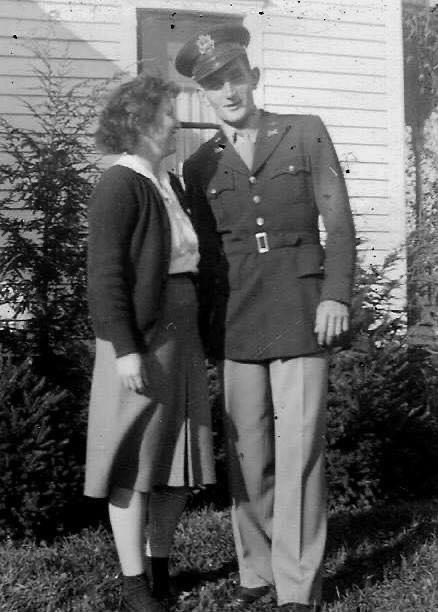
Chapter One: The Beginning in the End
I was over 50 years old before it dawned on me that the most important events of my life happened before I was born. The journey to that realization started as my father was dying. Oxygen was reaching his brain intermittently through clogged arteries, so there wasn’t much that we could share when I went to visit, but he could recall past events. This was the late 1990s when places like the Smithsonian were encouraging people to record World War II veterans. I told him I was going to work on an archive of all the papers, photos, and memories that Mom and he had saved. I bought a cheap tape recorder—way too cheap for the purpose but it didn’t matter. He didn’t like it, so I held it out of sight. I made the worst recordings in the world. He did like to sit with me and talk. I didn’t bother to come up with interview questions. He’d been telling and retelling a repertoire of amusing stories about his time in the service ever since the 1970s when he had started going to reunions of his old Army unit. I thought that’s what I’d hear along with some family memories.
I was of course painfully naïve. I had assumed those stories captured his experience. He’d been an Army engineer, so if I thought at all, I thought he’d been repairing roads somewhere behind the action. As a result I was puzzled when he repeated with some concern, “I won’t tell you about the bad stuff.” As I learned, he had seen some very bad stuff indeed.
Dad died not long afterward. I continued working on my archival project with Mom, who started to spend the summers with me. One spring, driving up from Florida to Chicago, she wanted to stop off in Georgia to visit one of Dad’s old Army buddies, T.C. Moore, and his wife, Mildred. I brought along my laughable tape recorder, thinking I’d add his memories to the mix. I sat in the living room with T.C. while Mildred and Mom sat in the kitchen nearby. I think because I was both someone he hadn’t known and his friend’s daughter, he was more willing to talk openly with me than Dad had been. T.C. didn’t need to protect me in the same way. He also wanted his friends who could no longer speak for themselves to be remembered.
Dad had a story about arriving at the front for the first time. Dad’s story was about asking a grizzled veteran, “where is the front?” The veteran replied, “you’re it” as he walked off. Since the story seemed to be one the guys had told and retold—it’s even in the division history—I thought T.C. might have a version of it to break the ice. I asked him, “how did you know you were near the front?” He replied thoughtfully, “I guess it was when we started to see the body parts in trees.” I had had no idea. But neither had Mildred or Mom. As he went on talking to me, they can be heard in the background on my tapes exclaiming to each other, “had you ever heard that?” “no, I had no idea.” I realized that I had accidentally broken through 60 years of silence.
As I searched for more information about Dad’s unit, I discovered that the silence wasn’t just the men who had been there. I was having a hard time finding out what their unit had actually done—I couldn’t find the combat engineers, nor their regimental combat team, nor their division, nor even the Seventh Army. I knew that they had fought in the Vosges Mountains. I’d pick up “complete” histories of World War II and look in the index. Nope, no entry for the Vosges Mountains. No entry for the Seventh Army. It was puzzling. I went to reunions. I went on battlefield tours. I read memoirs.
And then, new books started to come out. I discovered that the U.S. Army itself, which had written official histories about all the other Armies soon after the war, had not written the history of the Seventh Army until the mid-1990s. There was a larger silence than Dad’s at work.
I still hadn’t grasped what I didn’t understand about Dad until I read the letters. I had known there were letters. I had accidentally found them one sunny summer day when I was 21, sitting on the front porch, helping Mom sort through some boxes that had been in the basement untouched for thirty years. I lifted the lid of a shoe box filled with envelopes, slipped a paper out of its envelope, and read the greeting. Mom leapt across the porch and snatched the box from my hands.
One day, after Dad had died, Mom walked out of her room and handed the box to me. She’d organized the letters by date. She, who was so private, wanted Dad’s story, her story, to be known. I opened the first one up. I literally didn’t recognize the handwriting. I don’t think I’d ever gotten a letter from my father. If he wrote something, he printed it in that precise printing that engineers learn for blueprints. More than the handwriting, I didn’t recognize the words—they spoke of his feelings, his worries, his struggles. I didn’t know this person at all. This boy, who one day would be my father, was an utter stranger to me. The letters began before the war, when he was in college, and I began to realize something about the transformation that Mom and Dad had lived through.
I think for Mom my project was a way to process her grief. With time I realized the scope of her losses. She had lost her husband of 56 years, but long before, she had lost the boy she had fallen in love with. She had lost the town that she had grown up in. And, for a while, after the war, she had lost herself.
It was Dad’s story, but it was also Mom’s. Her letters didn’t survive, so I began investigating. I realized that the war had swept over everything they had grown up with, transforming the fabric of their lives into something unrecognizable. The war—the long build up and aftermath–had turned Margaret Youngs and Gordon Morse into the people I knew as Mom and Dad, the people who had lived in profound silence.
These are the lives I’ve reconstructed through documents, photos, letters, and research. They might not have become the people I knew had times been different. It felt wrong to refer to these people with other possibilities as Mom and Dad, but it also felt wrong to call my Mom and Dad by their given names when I recount the things we shared. When they told me things, it was always filtered through our relationship and edited by the tricks of memory across the decades of silence. And so I have called them both. The people I’ve met through research are Margaret and Gordon. The people who talked to me are Mom and Dad.
Whenever I mentioned my project to others, it was clear that I wasn’t the only one who had grown up in silent homes. Person after person told me that they had no idea what their father, their grandfather, their mother had experienced during the war. I eventually realized that it wasn’t enough to make an archive. I had to find the words, not just for Mom and Dad, but for the others whose story was left unsaid.
 Patricia L. Morse