
In researching the article about the Confederate monument in Oak Woods Cemetery, I stumbled into the fact that Chicago harbored Confederate sympathizers. It made me question my assumption that Hyde Park had been Lincoln country. I was glad to find that, while I can’t prove the general attitude in what was then a small town, there were definitely some loud voices for the Union and against slavery. I figured I’d talk about a few of them since they’ve faded from memory.
One of my favorites is J. Y. Scammon, partly because when I first looked him up 15 years ago, I could find almost nothing about him. In the meantime, much more has appeared online. In an age when wealthy men like to slap their names on institutions at bargain prices, I was surprised to find out how important he was to the history of Chicago and yet his name is on so little—just a grade school and a small patch of grass inside the University of Chicago Laboratory Schools quadrangle.
Scammon, who lived from 1812 to 1890, was originally from Maine, where he’d become a lawyer because a childhood injury to his left hand had made farming out of the question. He was one of the ambitious men who followed the Erie Canal to the Great Lakes and Chicago, a bustling town of 1,500. He arrived right when the land boom was on after the Treaty of the Three Fires forced the Potawatomie, Ojibwe, and Odawa out of Illinois so the Jackson government could make money selling the land. His first wife was Mary Ann Haven Dearborn, a niece of General Dearborn, who gave his name to the tiny fort on the Chicago River whose footprint you can still see at the Michigan Avenue Bridge.
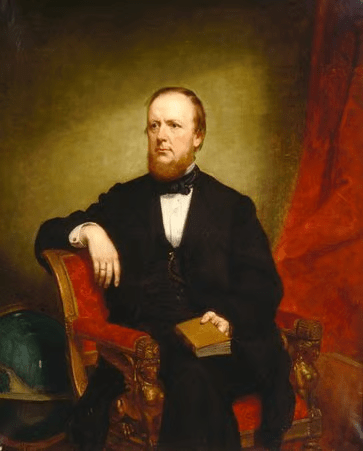
Starting a city from scratch, Scammon had a vision of what a great community should look like. In 1837, he got the legislature to charter the free Chicago Public School system. It was a tough fight that went on for decades because the land speculators didn’t want to fund it. In 1844 he created the first newspaper, the Chicago Daily Journal, the first in a series of newspapers he founded that ended with my favorite, the Chicago Inter Ocean. After an early attempt to have a railroad failed, he went all in to bring the Galena and Chicago Union Railroad to life. Since the banks wouldn’t fund it, he traveled all along the route, convincing farmers to invest in their futures. He served on the boards of banks and insurance companies and worked for Free-Soil politics.
Scammon was an ardent Swedenborgian. Swedenborg held that individuals accepted divine truth through their inner light and that “nature” reflected spiritual realities. Swedenborg’s writings had a profound influence on Emerson and the Transcendentalists. Perhaps that added to Scammon’s pleasure in creating beautiful landscapes and gardens. In 1854, he was central to creating Oak Woods Cemetery as a landscaped oasis, a new style of cemetery. Cornell consulted with him about the South Parks proposal. When critics said it was useless to plan parks in a landscape no better than a “frog pond,” the supporters pointed to Scammon’s Oak Woods Cemetery as proof that the area could be made into a park of undulating ridges and lagoons (Chicago Evening Post 3-20-1869). Scammon loved gardens. His first house was at Michigan and Randolph, where he had what was called the finest garden in the city. He later moved to Michigan and Congress, where he created another beautiful garden on what was called the most desirable and expensive property in the city.
He also devoted time and financial resources to building up Chicago’s institutions. He founded the Chicago Historical Society in 1856, the Chicago Astronomical Society, the Chicago Academy of Sciences, a hospital, and the original University of Chicago. He funded the Dearborn Observatory, with the largest refracting telescope of the time, named for his first wife. The telescope is still functioning, now at Northwestern. He also created the Illinois Humane Society in an age when animals were neglected, abused, and worked to death.
He never admitted to being active in the Underground Railroad, since after all, that would mean as a lawyer that he had broken the law. But he was often accused of it. When asked in court if he would refuse a summons to a posse under the Fugitive Slave Law, he said he’d obey the summons, but he would be sure to stub his toe and fall down on the way to join it.
He was a friend and supporter of Abraham Lincoln—so much so that when Lincoln was assassinated, he gave the family a way forward. Lincoln’s son Robert joined his law firm. They brought Mary Todd Lincoln to stay in the elegant Hyde Park Hotel as a quiet retreat, cooled by lake breezes that summer, until a scarlet fever outbreak in Hyde Park drove her away.
Scammon was known for his relative caution in a booming Chicago rife with speculation, but it didn’t protect him in 1871 when his home burned as well as his business and buildings that provided him rent income. As he struggled to recover, he was hit by the economic panic of 1873, which meant rent income dropped, and a second big fire in 1874 destroyed most of his existing buildings. Years of litigation over debts and mortgages took their toll.
Rather than rebuild in the ever-expanding city after the fire, Scammon retreated to Hyde Park to the 20-acre estate that his second wife owned, called Fernwood Villa. He fit in with Hyde Park society. He presented papers and discussed others at the Hyde Park Philosophical Society and Annie Hitchcock’s Hyde Park Lyceum. Ever a believer in landscape architecture, he turned Fernwood into a lovely space between Woodlawn and Dorchester, 59th and 58th Streets with the help of landscape architect Horace Cleveland. Though Scammon didn’t have the money to execute Cleveland’s plan, the neighborhood remembered it as a beautiful oasis for most of a century.
After J.Y.’s death in 1890, his widow financed her old age by donating some land and selling the rest to the also ever-expanding University of Chicago on condition that the garden be a place that would remain open to the neighborhood, a place where children could play. As Susan O’Connor Davis discovered, just days after the sale, before she had to leave her beloved Fernwood, Maria Scammon died. Scammon Garden was a lovely green park for the neighbors.
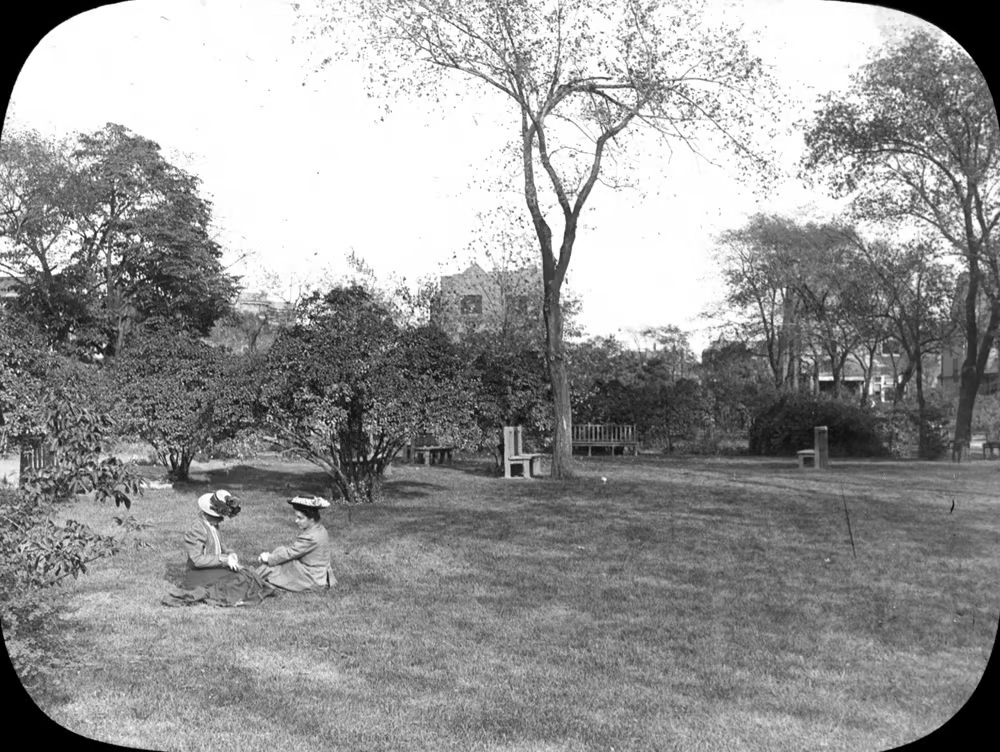
It provided a setting for a performance of Shakespeare’s Twelfth Night in 1906. Given J.Y.’s love of words, I think he would have been happy to know Shakespeare was happening there.
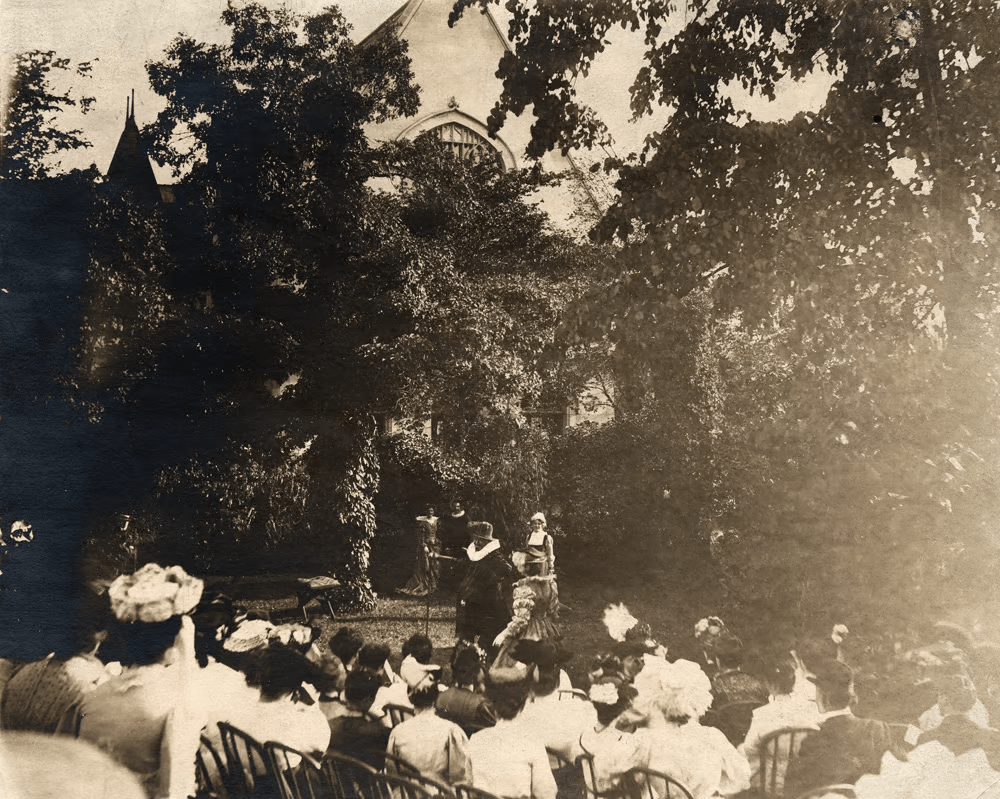
For a long time, the scent of lilacs along 58th Street was famous every spring. The name, Scammon Garden, lingered into the new millennium until the University had other plans. It’s no longer a bit of Swedenborgian nature. The plaque Maria Scammon stipulated is covered in ivy on the north side of Blaine Hall in a closed courtyard.
If you go to Oak Woods Cemetery, to see the Confederate Mound and the other sights, do take a moment to remember Jonathan Young Scammon. His name really should be on something.

 Patricia L. Morse
Thanks for this, Trish.
Visitors may also be interested in my 2015 page (http://pete.zelchenko.com/scammon/ or j.mp/savescammon) for much more detail on the issues around the University and Lab School’s longtime refusal to pay proper respect to the Scammon family’s contributions to the neighborhood and the school.
I am very curious about the current status 10 years after my work on this. I am in China; otherwise, I would go and check whether University of Chicago has done anything to correct the record and honor the memory of Maria Sheldon Scammon and Jonathan Young Scammon. The last I checked (2016), the sole thing they had were a couple of enamel placards labeled “Scammon Garden” around the north fence. My evidence shows that this a longtime misnomer (see my presentation and open letter, presented to HPHS and others, available at the above link). Not only that, it does not even constitute the bare legal minimum of their obligations to the Scammon family. If anyone has a chance to see what’s going on there, I’d be very curious. So might some of my friends in the Scammon family. Please feel free to write me at pzelchenko [at] yahoo [dot] com.
(P.S. I doubt any educational historians have ever checked into this, but the Sheldon family of New York also founded the Oswego Movement — yes, the Edward Austin Sheldon, who brought Pestalozzi’s ideas to America. Maria — born 1823, two years earlier than Edward — is likely a relative {any genealogists out there? Maria traces back to the Job Sheldon line, Delhi, Delaware County; Edward, to Asa Sheldon 1722}. Maria was key to Dewey’s progress, and Edward was key to Pestalozzi’s spread in America. It’s too bad that the Scammon name, and women, do not enjoy more prominence in the history of modern education in America.)
LikeLike