
(A repeat post)
As we head to the November 5, 2024, election and the signs are that women’s votes will make a difference, I thought I’d repost this. Illinois was the first state to ratify the 19th Amendment, though in their rush, there was a technical problem that had to be redone. It took over a year to get enough other states to ratify it. In researching, I stumbled into a work I didn’t know existed—A Woman of the Century—a collection of short bios for 1,470 women assembled by Frances E. Willard and Mary A Livermore for sale at the 1893 World’s Fair to argue for the role of women in public life. The century was the late 19th Century. The biographies were also meant to encourage women by including the information on how the woman got started in her field of endeavor. Her official reason for starting to write as presented in the Woman of the Century was her brother teasing her to try because her letters were so entertaining. It seems fairly clear, given the timing, that she started out of economic necessity.
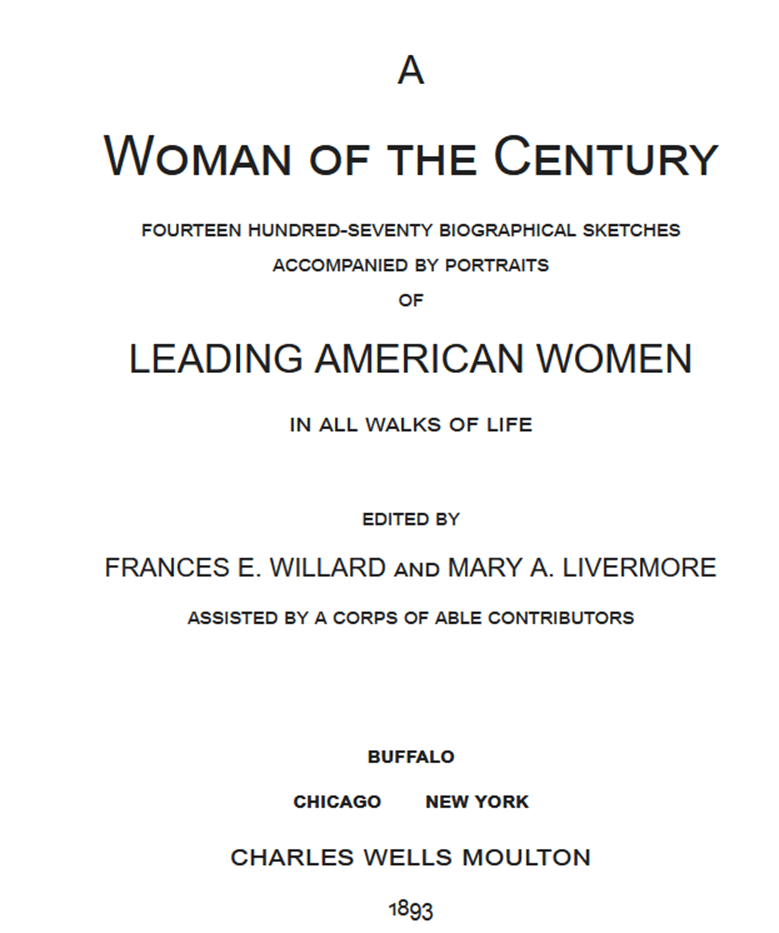
The editors announced their purpose in the foreword:
The nineteenth century is woman’s century. Since time began, no other era has witnessed so many and so great changes in the development of her character and gifts and in the multiplication of opportunities for their application. Even to those best informed on this subject, we believe that a glance at these pages will bring astonishment at the vast array of woman’s achievements here chronicled, in hundreds of new vocations and avocations.
I’m looking forward to diving into it. Needless to say, with 1,470 names, there are many women I know nothing about. I bumped into it because I was looking up Clara Louise Burnham, a Hyde Park novelist who wrote my favorite book about the fair, Sweet Clover: A Romance of the White City. You can read it here: https://www.gutenberg.org/cache/epub/54490/pg54490-images.html
This link is to the original. There are also several mangled reprints that cut the first 25% of the book and have ludicrously misleading covers. The missing section includes descriptions of Hyde Park before the fair and also explains the plot, rendering what’s left inexplicable. Even the original doesn’t have much of a plot, but it talks vividly about the experience of walking around the fair. I helped with online transcriptions of diaries of the fair for the Newberry Library during Covid shut down and they were mostly laundry lists of what they could see in a day with almost no descriptions or reactions. Diaries were very small little books, so it makes sense they were brief. A lot of the other descriptions are guidebooks or guidebook adjacent, sometimes written before the fair opened. Or there were comedic efforts like Samantha at the World’s Fair, written in sometimes painful vernacular but pointed humor. Susan B. Anthony and Frances Willard were big fans.
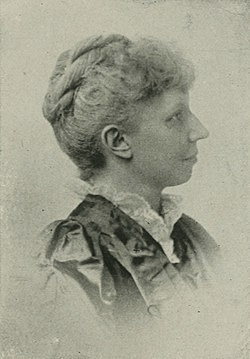
I’ve known about Burnham for a long time but hadn’t known her famous family. Her maiden name was Root. Her father George F. Root was a music publisher, particularly famous during the Civil War for his beloved anthem “The Battle Cry of Freedom.” Weirdly enough Clara with both Root and Burnham in her name seems to have had no relationship with the architects Burnham and Root.
Clara married a lawyer named Walter Burnham, who was apparently completely unremarkable—at least, to the newspapers. He died young. After that, Clara moved in with her famous father, George F. Root, spending summers with the family in their cottage on the coast of Maine. In her last years, she lived in the Cooper-Carleton (now the Del Prado). She started writing around 1880, which coincided with her husband’s health failing. In addition, her father’s firm had taken a huge loss in the Chicago Fire of 1871.
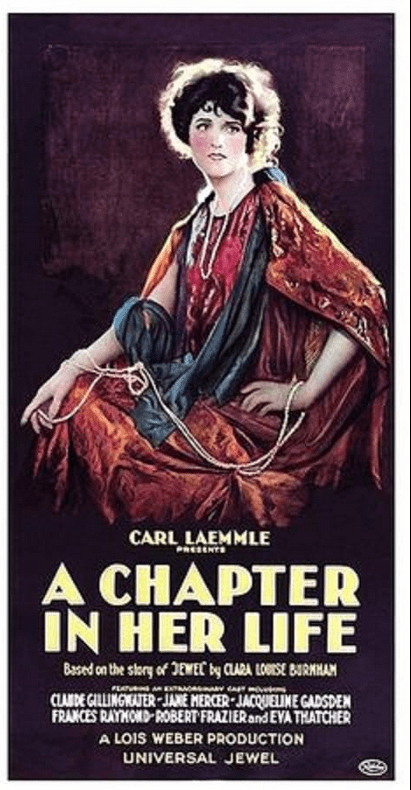
She was rejected at first but in the end published 26 novels, sold half a million copies, and had a national audience. Several of Burnham’s books were made into plays and movies. The movie version of Jewel came out in 1915 and was remade in 1923 as A Chapter of Her Life–directed by a woman, Lois Weber. Clara’s name appeared above the stars on the poster, so her fame lasted in her lifetime.
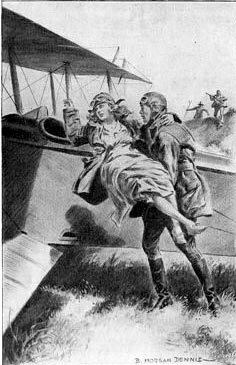
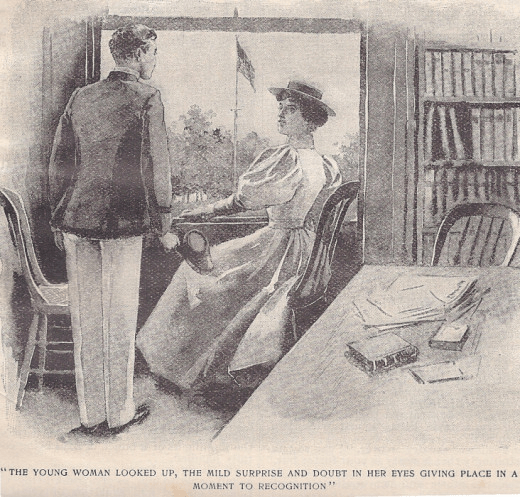
Burnham was a Christian Scientist and three of her novels took that as a theme: The Right Princess, Jewel, and The Leaven of Love. They were praised by Mary Baker Eddy, the founder of Christian Science, herself, who called her a “metaphysical surgeon.” Later, Eddy asked her to change the endings so the romantic couples didn’t marry and finally said that Christian Science couldn’t endorse fiction in any form. That had to have hurt. Maybe scenes like this one illustrated in Apple Blossom Time were too steamy for Eddy.
I haven’t read Apple Blossom Time, but most of what I’ve read is more like this illustration of a young woman at a window looking up at a young man in mild surprise.
Clara Louise Burnham died in 1927 at the family cottage in Maine. In her lifetime, she got to vote in exactly one presidential election.
 Patricia L. Morse