
Part II of Two Hyde Park High School Athletes
This is the story of two Hyde Park High School athletes—and the road not taken. Part I covered Walter Eckersall, who found the special treatment of football fame toxic in the end. His Hyde Park High School teammate had a very different story.
Samuel L. Ransom isn’t in the University of Chicago Athletic Hall of Fame, but he would have been. Ransom, Eckersall’s teammate, was an essential part of the Hyde Park High School team that beat the Maroons and crushed Brooklyn. He scored seven touchdowns in the rout. All that, even though, as Eckersall recalled, he played with a special target on his back as the only black player.
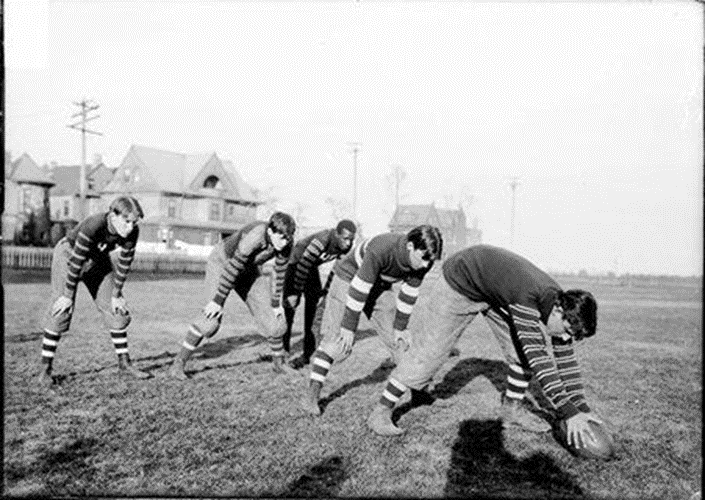
Ransom was a more versatile athlete than Eckersall. He lettered in four sports in each of his four years at Hyde Park High School. He was the catcher for the baseball team that captured the Midwestern Prep School title.

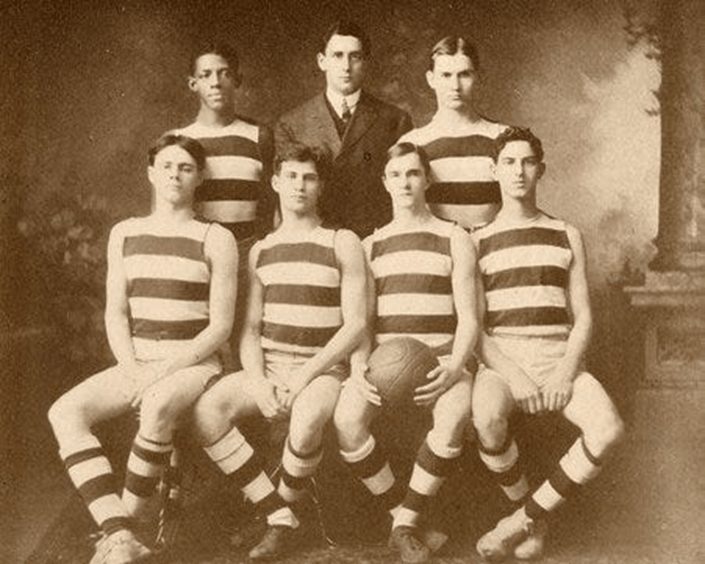
He won the discus, high jump, and broad jump on the 1903 Hyde Park High team that won national indoor and outdoor championships, sponsored by Stagg. And when Stagg staged the first national invitational tournament in the brand-new game of basketball, Ransom was on the team that won.
Ransom did all that and aced his studies, completing his homework on breaks while working after school as a bell boy in the Del Prado Hotel on the Midway, which catered to rich white Southerners. That may have played a role in his wanting to leave the area, though Stagg tried very hard to woo him for the University of Chicago. He may also have already been wary of the “winning is everything” football ethos.
Ransom instead went to Beloit College, where he could be a student athlete. Football was just another sport. The well-being of the school didn’t depend on winning. Ransom is believed to be the first African-American to play college basketball. Certainly he was the first at Beloit because he helped nail up the first baskets. They needed him and his mastery of the game. He led the 1904–1905 Beloit team to a 9-4 record. In 1906-1907, the basketball team went undefeated.

During the 1904-05 basketball season, a Round Table reporter described Ransom’s prowess on the court: “Sammy Ransom at guard won the hearts of the fans. In a game he seemed to be everywhere covering an almost incredible amount of territory. No man that he played against was able to keep free from him. His cleverness as an individual player was surpassed by his part in the team work…” from Fridays with Fred: Basketball comes to Beloit. At Beloit, he once more lettered all four years in four sports. It had to be a little sweet when his Beloit football team defeated the Maroons. It had to be bitter, however, when his team stayed in the Del Prado Hotel, and the Southerners created an incident when he sat down with his team to eat in the dining room. He quietly left. The Tribune reporting on the incident was sympathetic with Ransom against the Yellow Fever crowd. They’d admired him during his years at Hyde Park High.
After graduating from Beloit in 1908, he played professional baseball with a barnstorming black team from St. Paul, Minnesota. Later he settled in St. Paul.
When the United States entered World War I, Ransom returned to Chicago so he could serve with the famous 8th Infantry Regiment, also known as the 370th, the all-black National Guard unit.

He entered as a second lieutenant and was promoted to first lieutenant during combat in France. When Eckersall, then writing for the Tribune, heard that Ransom was badly wounded, he wrote an essay titled “Sam Ransom: Fearless in War or Sport” in which he recalled that “Ransom commanded the respect of his teammates and adversaries alike….He was hard as nails; speedy, agile, and smart…. Sam was a valuable man on offense and also a tower of strength on defense. He had the faculty of sizing up opponents’ plays quickly and moving to the point of attack before the play reached the line of scrimmage.”
Sam Ransom returned to Minnesota after the war. When World War II broke out, he served as a major in the Minnesota National Guard, appointed by the governor as a member of the Interracial Commission to integrate the units, one of the first states that did. The Minneapolis Star ran a profile of him in 1942, with the headline “Sam Ransom, War Hero, Among Greatest Athletes.” He died at 87 in 1970, admired as a pioneer of civil rights in Minnesota.
In an interview, when asked about Eckersall and the opportunity to play for Stagg, Ransom replied, “I may have been a greater athlete had I gone to Chicago, but by going to Beloit I am a better man.”
 Patricia L. Morse